PERFECT CENSORSHIP – OPEN CALL
GESELLSCHAFT FÜR ZEITGENÖSSISCHE KONZEPTE e.V.
Glitch Art in the Age of Perfect Censorship
DE GLITCH ART IN THE AGE OF PERFECT CENSORSHIP
Registration requested - kontakt(at)verena-voigt-pr.de
Hybrid Launch Event: 18 June, 6 pm
Digitalvilla, Hedy-Lamarr-Platz, Potsdam-Neubabelsberg & on ZooM
The artistic-curatorial documentation project Glitch Art in the Age of Perfect Censorship and the accompanying OPEN CALL by Verena Voigt and Ian Keaveny aka crash stop examine artefacts and artistic concepts that have been blocked, downgraded, or marked as problematic by algorithmic systems. At the centre of the project are artistic protest practices within Glitch Art that use damaged images, disruptions, compression errors, and digital artefacts to expose the cultural politics of platform regimes while simultaneously triggering an algorithmic risk score — whether accidentally or through deliberate provocation.
On 18 June at 6 pm, we will present our initial findings and introduce the first artists who have shared their experiences of shadowbanning, downranking, demotion, and appeals processes.
It appears that precisely those qualities associated with Glitch Art — instability, ambiguity, and fragmentation — are increasingly labelled as risks by automated systems. Our preliminary investigations into algorithmic content moderation suggest that statistical patterns play a significant role in these processes. In this respect, Glitch Art functions as a revealing stress test for algorithmic data processing.
At the beginning of our research, it seemed as though the digital artefacts of Glitch Art were being read by machines. But is this really the case? Do they actually pass through automated moderation systems that determine whether they remain visible, lose reach, or disappear from view? Has visibility truly become an algorithmically managed resource? Or is the situation altogether more complex?
A central point of departure for our investigation is Meta – Requiem of a Dream, a video essay by Ian Keaveny aka crash stop (IRE), first presented as part of the exhibition GLITCH: Ontological Exhaustions & System Failures at Spazju Kreattiv in Malta. The video essay explores forms of algorithmic moderation and regimes of visibility, while reflecting on the deeply personal impact of automated restrictions on the Irish artist, who is active as a curator within the GLITCH ART COLLECTIVE. It also addresses his direct experiences of automated restrictions and the misclassification of works by numerous GLITCH ARTISTS.
The video essay describes a platform culture in which images no longer circulate primarily through human perception, but are increasingly pre-selected, filtered, and evaluated by machine systems. The project seeks to understand these hidden structures of digital control — including their intercultural dimensions and their implications for future forms of data sovereignty.
At the same time, the artistic-curatorial documentation raises the question of who actually governs these systems. Behind the apparent autonomy of artificial intelligence stand millions of data workers, content moderators, and annotation teams around the world whose labour remains largely invisible. They classify images, flag content, train datasets, and correct erroneous decisions. The black box of the platforms therefore consists not only of algorithms but also of human labour, often outsourced under precarious conditions. The history of algorithmic moderation is also a history of invisible workers.
The curatorial documentation is conceived as a growing archive and laboratory of algorithmic perception. Its starting point is a poster developed by Ian Keaveny, which will be continuously expanded through additional case studies, artefacts, and documented interfaces. The aim is to make the invisible infrastructure of cultural control visible and, within a RISK SCORE GALLERY, to investigate the interactions between platforms, algorithms, data workers, artistic protest, and curatorial protection.
Within the context of Brandenburg, historical lines of continuity also become visible. Prior to 1989, cultural control in parts of Germany was often exercised not only through overt prohibitions but also through more subtle mechanisms of social, psychological, and administrative regulation. Today, overt censorship is supplemented by a new operational architecture: systems that do not primarily prohibit, but rather organise perception, attention, reach, and probability. The focus thus shifts from classical censorship towards the regulation of visibility itself.
In this sense, PERFECT CENSORSHIP becomes not merely a project about Glitch Art, but about the entire political economy of algorithmic visibility.
Curated by Verena Voigt M.A. (Investigative Curator, GFZK e.V.) and Ian Keaveny aka crash stop (Glitch Artist).
FALLING FROM THE SHOULDERS OF GIANTS is an art project funded within the framework of Von hier aus Zukunft – Kulturland Brandenburg 2026/2027. Kulturland Brandenburg is funded by the State of Brandenburg with the generous support of the Brandenburg Savings Banks.
Glitch Art in the Age of Perfect Censorship forms part of the project FALLING FROM THE SHOULDERS OF GIANTS and is embedded within the two-year arts programme of Kulturland Brandenburg.
IKT - SPOTLIGHT
INTERVIEW
VERENA VOIGT M.A.
:
Fubar GLITČH Practices Docu Series - Ian Keaveny
:
What I find particularly fascinating about Instagram and other American platforms is how profoundly their approach to censorship stands at odds with a European sensibility. Every moderation system carries its own politics and its own built-in biases. The way visibility is managed, restricted, or allowed is never neutral; it reveals the values, assumptions, and power structures embedded within the architecture of the platform itself.
— Ian Keaveny
:
EINLADUNG - OPEN CALL_Glitch Art in the Age of Perfect Censorship
:
OPEN CALL
GLITCH ART IN THE AGE OF PERFECT CENSORSHIP
A Long-Term Documentation by Verena Voigt (GFZK e.V.) & Ian Keaveny aka crash stop
The exhibition project Glitch Art in the Age of Perfect Censorship is conceived as a documentation and participation format that makes visible new forms of algorithmic moderation and invisible cultural control. Beginning with an evolving poster format developed by Ian Keaveny aka crash stop, the project initially documents artistic works and experiences affected by platform filtering, content moderation and algorithmic visibility regimes.
We are seeking artists, researchers and practitioners whose work or experiences within digital environments engage with the following questions:
- algorithmic censorship
• shadow banning and downranking
• content removal and moderation
• “sensitive content” labels
• AI-based misclassifications
• fragmented, synthetic or unstable body representations
• glitch aesthetics and machine vision
• platform governance and behavioural architectures
• invisible forms of digital control
• interfaces as cultural artefacts
We are particularly interested in works and experiences by artists who have:
- been blocked, removed or restricted
• experienced unexplained drops in visibility
• triggered moderation systems without any understandable explanation
• been marked as sexual, explicit or problematic despite artistic intention
• revealed contradictions within automated systems
Submissions may include:
- images and video works
• glitch artefacts
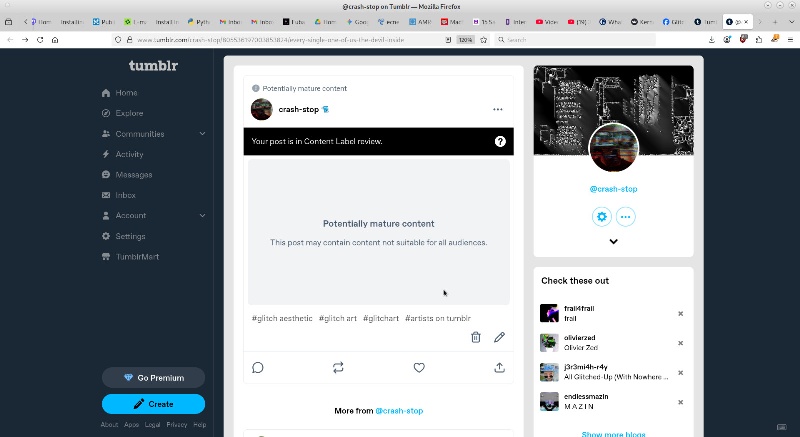
• screenshots documenting warnings and platform notifications
• moderation notices and artist statements
• personal testimonies
• documentation of encounters with automated systems
We are interested not only in removed images, but also in subtler forms of intervention: warning messages, delays, invisible filtering mechanisms, suspicious interfaces and algorithmically generated uncertainty.
The project asks:
Who — or what — curates visibility today?
Selected contributions will become part of a growing curatorial documentation, archive structure, poster series and future exhibition and project contexts within FALLING FROM THE SHOULDERS OF GIANTS at the Digitalvilla in Potsdam-Neubabelsberg.
Contact:
kontakt(at)verena-voigt-pr.de